Free PDF Low-Level Programming: C, Assembly, and Program Execution on Intel® 64 Architecture
By downloading this publication soft documents, you can begin reading Low-Level Programming: C, Assembly, And Program Execution On Intel® 64 Architecture from currently. It will certainly not require you to always review it every single time. Juts use your spare time even few minutes. This is why when you wish to see just how guide web content is provided; you should read it from the front web page. Yeah, spend your time to read it. This is our most suggested publication to check out when you intend to opt for some journeys as well as vacations.
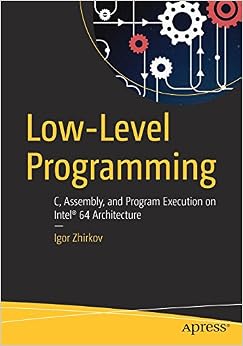
Low-Level Programming: C, Assembly, and Program Execution on Intel® 64 Architecture

Free PDF Low-Level Programming: C, Assembly, and Program Execution on Intel® 64 Architecture
After couple of time, lastly guide that we and also you wait on is coming. So soothed to obtain this fantastic publication readily available to provide in this website. This is guide, the DDD. If you still feel so difficult to obtain the published publication in the book store, you could accompany us again. If you have actually ever before got guide in soft file from this book, you could conveniently get it as the recommendation now.
Why must be book Low-Level Programming: C, Assembly, And Program Execution On Intel® 64 Architecture Publication is among the very easy sources to look for. By obtaining the author as well as theme to get, you could locate so many titles that provide their information to acquire. As this Low-Level Programming: C, Assembly, And Program Execution On Intel® 64 Architecture, the impressive book Low-Level Programming: C, Assembly, And Program Execution On Intel® 64 Architecture will provide you exactly what you should cover the work deadline. And also why should remain in this website? We will ask initially, have you much more times to go for going shopping guides as well as hunt for the referred book Low-Level Programming: C, Assembly, And Program Execution On Intel® 64 Architecture in publication store? Lots of people might not have sufficient time to find it.
You may not really feel that this publication will be as important as you assume now, yet are you certain? Discover more regarding Low-Level Programming: C, Assembly, And Program Execution On Intel® 64 Architecture and also you can truly discover the benefits of reading this publication. The given soft data book of this title will offer the amazing scenario. Also analysis is just hobby; you can begin to be success b this publication. Think extra in evaluating guides. You could not judge that it is very important or not now. Read this book in soft file and get the methods of you to save it.
Getting this publication in this web site could not lead you to walk and go to publication shop. Seeking shelf by shelf will actually spend your time mostly. However, it well not assurances you to be successful searching for Low-Level Programming: C, Assembly, And Program Execution On Intel® 64 Architecture Therefore, you can discover it in the soft documents of this publication. It will offer you the incredible system of guide recommendation. You can check out the link and also go to the web page making manage. And now, your book sort data of this can be your picked publication and also area to read this fascinating publication.
Product details
Paperback: 464 pages
Publisher: Apress; 1st ed. edition (June 29, 2017)
Language: English
ISBN-10: 9781484224021
ISBN-13: 978-1484224021
ASIN: 1484224027
Product Dimensions:
7 x 1 x 10 inches
Shipping Weight: 2 pounds (View shipping rates and policies)
Average Customer Review:
4.0 out of 5 stars
15 customer reviews
Amazon Best Sellers Rank:
#22,843 in Books (See Top 100 in Books)
tl;dr: buy this book if you're interested in the underlying principles of low-level programming. If you just want to learn some C and assembly, there are plenty of free tutorials online. The book is probably too terse for absolute novice programmers but is a delight for those with some experience who seek to learn basic concepts of low-level programming while systematizing their gut feelings of programming patterns and good practices into a coherent view.There are books on programming that are best used as references, standing on one's desk and waiting for its owner to forget a name of a handy function. Then there are books that seek to land their readers a job by providing the minimal knowledge required to pass a programming iterview and do some productive programming, learning the missing pieces later in the field. And then there are books that outline the underlying principles on which programming is built. The present book is of the latter kind.That isn't to say the book can't be used to land a job. The presented examples and topics are not merely for academic pondering but practical enough for a reader to be able to apply the acquired knowledge in the field. However, if one just wants to start writing assembly and C, this book is probably an overkill. It doesn't hold one's hand and requires much more effort from the reader than necessary to start producing working code, so if one's goal is to be able to read and write some C, online tutorials would probably be a better place to start.Who is this book for, then? Well, one of its major focus is on good practices, so if one is somewhat experienced in programming, the book can help to solidify the intuitive understanding of how to write. The other focus is on the underlying principles of low-level programming: many connections to other branches of computer science are provided, putting low-level programming into a broader perspective, which results in better programs. For example, one doesn't exactly need to know about finite-state machines, but structuring an assembly program to resemble this concept helps significantly to produce listings that are easy to read and debug. Exposure to other models of computation doesn't have any immediate benefits, but if one familiarize themselves with Forth (an interpreter of which the book suggests to write), they are bound to use some little tricks inspired by it from time to time. How does knowing about parsing of formal languages help with low-level programming if one doesn't expect to write compilers? Well, it makes compiler messages more intuitive. And so on; I suggest that you look at the table of contents, available freely by clicking on the book cover, and observe the sheer breadth of the covered material.Of course, the book isn't limited to things that are only marginally connected to low-level programming. The programming itself is described definitively, with many helpful examples, assignments, and useful asides which warn about important caveats. I was sold the moment I saw a warning about a names of sections in assembly not being case-insensitive, because first, I've once spent an evening fighting with a mysterious segfault because of this, and second, I haven't seen a similar warning in any other resources. The book is good; however, I still believe that its greatest strength is in acquainting readers with indirectly related concepts, and reading it solely for the sake of learning how to write C isn't practical as there are many easily googlable free resources providing the means to acquire this skill.With all that said, I still believe that even though exposure to many different topics indirectly connected to low-level programming makes one a better programmer, beginners would be overwhelmed by the amount of content they have to absorb in addition to learning the basic concepts.Summary:+ Breadth+ Depth+ Interesting examples and assignments+ Caveats+ Instructions for tooling (often discarded in other books)- The book is quite terse (the consequence of being deep and broad)- The language in which the book is written is sometimes weird due to the Russian origin (for example, 'loop' is 'цикл' in Russian which is incorrectly translated as 'cycle' in some places, but 'loop' isn't even nearly the same as 'cycle'')DISCLOSURE: I'm personally acquainted with the author and have read the book before it went to print. However, I'm not currently one of his students and so will not receive good grades for this review.
Very well written book on Intel 64 architecture and programming using both Assembly language and C. Clear instructions, numerous code samples compilable from the first try and many assignment forcing the reader to apply his newly acquired knowledge to writing useful and quite complicated code from scratch. The chapters on using C and Assembly in ensemble are especially valuable. There are many good books about C but this one is the best I've seen so far on Assembly and its productive use with C.
Good information but presentation is a bit awkward. For example, each chapter heading includes the author's name and city. Language is also a bit stilted. But if you can get beyond those aspects, the information contained in the book is useful.
This book is about assembly language, mostly about C, and how to make them work together. What is written is written well, especially the first (assembly) part is good. It is truly engaging though I think the pace is too fast and the final problem (writing Forth interpreter) adds more noise than signal to overall content (just count it -- you are supposed to learn asm, low-level C, and Forth -- in my opinion it is too much) -- anyway, I immediately felt nostalgic about the times I wrote code in 6502 and 68K asm.Let me list all the drawbacks I noticed. The minor ones are the format of the book (taller, and narrower than usual) and persistently printing copyright notice over the pages. I don't know where APress is heading with it but I see it again and I am really tired of this. What next -- "you wouldn't steal a car..." warning?The big one starts with author's statement that there is no point in duplicating info about assembly language because everybody can check Intel spec. As the effect you get as little info as possible in a book about assembly. This decision made me really angry -- I paid for the printed book just to be reminded about existence of the internet? Now I have to switch constantly between book and computer monitor -- yeah, new dimension of comfortable reading.But what really broke the straw was page 127 -- beginning of the C part. Author included just a little info about asm because there is one spec available ("Many books try to include exhaustive information about instruction set. it gets outdated quite soon; moreover, it BLOATS the book unnecessarily.", upper case is from me)? Hear this -- there is entire C tutorial included, 140 pages long, even with programming style tips. It is probably because there is no other book about C on the planet, and K&R is about to be written yet. Yes, I am buying this reasoning, sure.Author also included such rare gems as description of regular expressions and finite state machines. But asm... oh big no-no, there is Intel spec already, every line of duplication is a crime ("There is no virtue in copying the instruction descriptions from the “original†place they appear in; it is much more mature to learn to work with the source.") Why a reader cannot work with the sources about regexes or grammars?As for wasting space I was also not happy seeing questions supposed to help me learn -- I read books because I am curious, to learn more, so my mind is already set on asking. I think it is more valuable to provide information than to ask and ask (because I am already doing that). "What does instruction xor rdi, rdi do" -- is it really valuable? There are 423 questions in total and I think they are geared more to make this book a textbook (making life easier for lazy lecturer) than to truly help any self-taught reader.It is not the book is not useful, far from it, author relies solely on open-source tools, I have learned about Intel asm (and Forth), part 3 (C+asm) showed me new low-level details. But despite all those good things this book is too heavily ill-balanced to get a higher score. The second edition will be good with the second part completely removed, or really great with expanded part one at the expense of removing part two. Until then we have to live with the average.
This is a great book for learning low level programming. Although, I am C++ programmer, I learned so much from it. Really get it and you won't be disappointed!
Detailed and broad in scope and coverage. However where is the editor? the author is not a native english speaker and it shows! There’s many grammatical errors that are common among slavic speakers (such as leaving out articles like ‘a’ or ‘the’).Great book, but the editor was either lazy or asleep!
Absolutely fantastic, a fantastic coverage of low level programming with C and x64, it's hard to find a decent tutorial these days that covers a working/modern version of assembly so this was a breath of fresh air. Kudos to the author.
This book provides the foundation of most of the languages. Assembly, Forth, C and their many useful references. Well done!
Low-Level Programming: C, Assembly, and Program Execution on Intel® 64 Architecture PDF
Low-Level Programming: C, Assembly, and Program Execution on Intel® 64 Architecture EPub
Low-Level Programming: C, Assembly, and Program Execution on Intel® 64 Architecture Doc
Low-Level Programming: C, Assembly, and Program Execution on Intel® 64 Architecture iBooks
Low-Level Programming: C, Assembly, and Program Execution on Intel® 64 Architecture rtf
Low-Level Programming: C, Assembly, and Program Execution on Intel® 64 Architecture Mobipocket
Low-Level Programming: C, Assembly, and Program Execution on Intel® 64 Architecture Kindle